September 8, 2008
To:
The Mayor City of Portland
389 Congress St.
Portland ME, 04101.
The Sudanese Community, on behalf of the family of James Angelo Okot, would like to register its frustration and grievances regarding the protection it is rendered in this city. The Sudanese Community lives under fear of many things, one of which is for the lives of its members, and second, for its inability to control the direction of the upbringing of its children. A string of tragedies have been inflicted on them (members of the Sudanese community) in such a short period of time in Portland, which we once thought was a safe city. This is no more; not only by crime committed against our community but also the lack of protection by the law enforcement authorities that have not been able to apprehend the criminals. The following incidences took place some with substantial evidences to have lead to arrest but no arrest ahs thus far been made of any single one:
James Angelo Okot was shot to death while at work on September 7th, 2008
Sam was severely beaten on the street of Portland in July 2008
Gun shots were fired at Mr. Martin Sonksi?s house on March 12, 2008 prompting him to move out of Portland
Mr. Deng was severely shot at Elm Street on December 14th, 2007
Edward Okeny was beaten around Kennedy Park on October 21st, 07 and died two weeks later
Mr. Charles Ben was beaten at his Parking lot at Riverton Park in July 2006, the culprits left their car at the incidence scene, which could have led to some arrests, but none was made.
Mr. Simeon Alolding?s son was shot in January 2002
As law-abiding citizens of the city of Portland, Maine and of the United States we feel that the authorities have let us down through lack of communication, which as the above incidences indicate, have created fear in supposedly our new home of hope. It does not help at all when so frequently; we are being reminded of what we ran away from.
For this, we demand justice and open communications that will result in the apprehension of the at-large culprits. Therefore, the citizens of the Sudanese Community here in Portland Maine should not be treated differently from any other citizens, nor should we live under constant fear of being targeted. We would like to strengthen our new home in America not by living in fear but by feeling protected. Only a sense of protection can strengthen the idea of being law-abiding members of society.
Should you have any questions, please do not hesitate to contact our spokespeople:
Sarah Espichio Edward Laboke
Nyalingwa@netzero.com ellaboke@yahoo.com
207.775.5249 207.712-6041
http://multimedia.boston.com/pub/m/20869910/sudanese_residents_in_portland_maine_no_longer_feel_safe.htm?pageid=1
------------------------------------------------------------------------
James Oryem Angelo
1981 - 2008
PORTLAND
James Oryem Angelo, 27, of Sherman Street died tragically early Sunday morning in Portland.
He was born in the Sudan on January 1, 1981 a son of Angelo Okot and Mary Tutuliano.
James graduated from Portland High School in 1999 where he excelled in the sport of soccer. He was an active coach in community youth soccer programs and Portland United soccer. James saw soccer as a vehicle to engage youth and build community in the Portland area.
He had been employed for the past several months as a security officer at Mercy Hospital in Portland. He was preparing for a career studying Criminal Justice at the Southern Maine Community College in South Portland. James will be remembered at Mercy Hospital for his soft spoken manner, kindness, and his warm smile. He was very committed to the safety and security of all patients and staff at Mercy.
James is survived by his mother and father of Portland and a daughter Elizabeth Amari Angelo. He is also survived by two brothers; Alfred Angelo of Biddeford and Stephen Angelo of Portland and four sisters; Lilly Angelo of South Carolina, Regina, Marcelina and Marianna Angelo all of Portland.
Relatives and friends are invited to visiting hours on Friday, September 12, 2008 from 9-11am and 3-5pm at the Independent Death Care Memorial Chapel at 471 Deering Avenue, Portland.
On Saturday, September 13, 2008, relatives and friends will gather at the Independent Death Care Memorial Chapel at 8:30am to walk to the Cathedral of the Immaculate Conception, 307 Congress Street, Portland. A Mass of Christian Burial will be celebrated at 10am on Saturday, September 13, 2008 at the Cathedral of the Immaculate Conception. Interment will follow at Calvary Cemetery in South Portland.
In lieu of flowers, donations can be made to the:
James Angelo Memorial Fund
c/o Human Resources Department Mercy Hospital, 144 State Street, Portland, Maine 04101.
Arrangements are under the guidance of Independent Death, 471 Deering Avenue, Portland. To offer words of condolence to the family sign an online guest book, go to www.independentdeathcare.com.
-----------------------------------------------------------------
'Why is this happening?'
Sudanese say violent incidents leave them living in fear
By TOM BELL and ANN S. KIM, Staff Writers
September 9, 2008
Family, friends and co-workers of James Angelo gather for a memorial service outside Mercy Hospital on Monday. Angelo was shot and killed early Sunday while working as a security guard at the hospital. Acting Police Chief Joseph Loughlin speaks to the media after the memorial service for James Angelo on Monday. Police are asking for the public's help in solving the case. To read the letter from the Sudanese community to the city, Download file Portland's Sudanese community expressed frustration Monday with what members see as the city's failure to curtail growing violence involving Sudanese victims. They voiced their concerns in response to Sunday's fatal shooting of James Angelo, 27, the son of one of Maine's most prominent Sudanese leaders. Angelo, an unarmed security guard at Mercy Hospital, was shot in a hospital parking lot along Winter Street shortly after 4 a.m. as he returned to work after a break. He died later that morning. An autopsy Monday by the state Medical Examiner's Office concluded that Angelo died from a gunshot wound in the area between his upper back and neck. Police, who have yet to identify suspects in the shooting, said multiple shots were fired. They have not said whether Angelo was the victim of a random attack. Witnesses described a possible interaction between Angelo and two people before the shots and reported that two people fled in opposite directions after the shots, according to police. On Monday, a delegation of 11 members of the Sudanese community met at City Hall with Mayor Ed Suslovic, City Manager Joseph Gray, acting Police Chief Joseph Loughlin and Rachel Talbot Ross, president of the NAACP's Portland branch and the city's director of equal opportunity and multicultural affairs. In a letter to officials, the Sudanese leaders said they no longer view Portland as a safe city. They said that police have not made arrests in several incidents of violence against Sudanese victims, particularly over the last two years. The letter listed seven unsolved cases, including a shooting in December of a 20-year-old Sudanese man who was standing outside a Somali community center, and an incident on March 12 in which an unidentified man fired four shots into the home of a Sudanese family on Hammond Street. That shooting prompted the family to leave the city. "The Sudanese community lives under fear of many things, one of which is the lives of its members, and second, for its inability to control the upbringing of its children," the letter said. Loughlin said he could not compare the level of crime affecting the Sudanese community with that of other groups in the city because he did not have statistics available. He said police are working hard to solve the cases listed in the letter and plan to make an arrest in one of them. The letter was delivered on behalf of Angelo Okot, the victim's father and president of the Sudanese Community Association of Maine. Okot described the group as having 2,000 members. He did not attend the meeting at City Hall. Earlier in the day, Okot said he had thought Portland would be a good place for his refugee family to settle. "Now somebody jealously came to rob my lovely son from me to kill him without cause," he said. After a memorial service for his son was held in the parking lot at Mercy Hospital, Okot said he had heard that his son was threatened at work on Aug. 16 in an incident that involved police and a group of young people. Okot said Angelo reported the incident to his supervisor, but Okot worried that not enough was done to ensure his son's safety. "I believe these kids were looking for him," Okot said. The hospital did not return a call seeking comment on the Aug. 16 incident. It has referred questions about the shooting to police. Police said the Aug. 16 incident is just one of many factors in their investigation. Loughlin said police are still working around the clock on the case but have not received many tips. He repeated a call for the public's help. Police are looking for two people who were on Winter Street at the time of the shooting. One was described as a short black man in his early 20s with a slight build and short hair. The man appeared to be clean-shaven and was wearing black pants and a white hooded sweatshirt with a design or print. The other person was described only as wearing a light-colored shirt or jacket. Police are asking anyone with information to contact them at 874-8479 or at police.portlandmaine.gov, by clicking on the citizen input link. Loughlin said he does not believe the Sudanese population is being targeted. "This affects our entire community," he said. "This insults our entire community." The tone of Sudanese leaders was more conciliatory after the meeting at City Hall. "It's not really that we feel bad about the police," said Edward Laboke, a relative of Angelo. "We feel, 'Why is this happening?'" Laboke said no assumptions could be made about whether the perpetrators of violence against Sudanese residents are from the Sudanese community or outside of it. "As long as he is a criminal or she is a criminal, we will not care if they are Sudanese or not," he said. Suslovic said the meeting included discussions about employment opportunities and activities for Sudanese youths. Many Sudanese youths feel alienated from Portland's mainstream culture, said Alfred Jacob, 25, who leads a youth program in Kennedy Park that's funded by the Portland Housing Authority. "Our youth are not engaged," he said. "We are not part of the city." Angelo's family is among the 6,000 Sudanese refugees who have resettled in Maine. The figure, provided by Catholic Charities Maine, the only refugee resettlement agency in the state, refers only to refugees for whom Maine was the first home in the United States. Sudanese resettlement in Maine continues today, although the numbers are small, said Arian Giantris, director of the refugee and immigration services program. The Sudanese resettlement in Maine began in the mid-1990s, surged in 2000 because of conflict in the Darfur area of Sudan, and has waned in the past few years, said Wilfreid Plalum, a Sudanese community leader who is related to Angelo. A significant population lives in the Lewiston area, and Sudanese are living in other parts of the state, but Portland has the largest number, he said. On Monday morning, several dozen people gathered for the memorial service in the parking lot where Angelo was shot. His mother, Mary Tutuliano, who works in the hospital's housekeeping department, collapsed and was helped to her feet by hospital staff members. As she walked into the lot, she sang a mourning song in the Acholi language, which is spoken by tribes in southern Sudan and in Uganda. The family's supporters also sang songs in Arabic, a shared language in Sudan. The songs included a Christian hymn, "In Heaven with God." The song speaks about people's ignorance in contrast to God's power to know the truth, according to family members who translated the lyrics. "No one knows about anything that happened," the mourners sang, "but with God there is nothing for him to know." Staff Writer Tom Bell can be contacted at 791-6369 or at: tbell@pressherald.com
Staff Writer Ann S. Kim can be contacted at 791-6383 or at:
akim@pressherald.com
Tuesday, September 16, 2008

Tuesday, June 3, 2008
we taking over
I'm fortunate that my work allows me to travel and become more knowledgeable about the political process on multiple fronts. So far I've traveled as far as Memphis and as close as a seventy five minute trip to Augusta. Yet it's never how far you go, it's always the people you meet that make the difference. I've caucused for the second time in my life and this past weekend I attended my first Democratic state convention.
Thousands of Mainers flocked to the Maine State Democratic Convention last weekend. You can probably read some of the more snarky coverage about the tedious process from several online news sources. And for those who remembered how long the Portland caucus was last February, safe to say the caucus was the initial test of patience. I attended not only doing some "delegatin'", I went knowing that this year's Democratic presidential nominees would attract an increasing amount of passionate young people looking forward to cutting their teeth in the political process for the first time of their lives.
On Friday evening, I sat on a panel with ten other young people to talk about the importance of young people being civically engaged in this upcoming election. The experience in politics ranged from organizing phone banks and voter reg drives in high schools to young people who decided to run for office in the state legislature. The questions that the audience and moderators asked drew to the importance of voting as part of a greater cultural movement towards activism and awareness about how issues are affecting our lives.
Saturday brought great speeches from both Clinton and Obama camps. It was a personal pleasure to see House Majority Speaker Glenn Cummings give a passionate speech about Barack Obama (not just because Barack's my man either). You can watch it here:
But beyond the candidate speeches, beyond the partisan language, what resonated the most was the fact that people felt compelled that they were a part of something bigger--a movement to drive for the change that is so desperately needed locally and nationally. Despite all the headlines, the rising gas prices, rising costs of living, declining jobs and economy, we're finally turning our rage into hope and change. We're taking the political process into our own hands.
And at the end of the day, that's what any activist wants to see happening in our state and our communities.
Thousands of Mainers flocked to the Maine State Democratic Convention last weekend. You can probably read some of the more snarky coverage about the tedious process from several online news sources. And for those who remembered how long the Portland caucus was last February, safe to say the caucus was the initial test of patience. I attended not only doing some "delegatin'", I went knowing that this year's Democratic presidential nominees would attract an increasing amount of passionate young people looking forward to cutting their teeth in the political process for the first time of their lives.
On Friday evening, I sat on a panel with ten other young people to talk about the importance of young people being civically engaged in this upcoming election. The experience in politics ranged from organizing phone banks and voter reg drives in high schools to young people who decided to run for office in the state legislature. The questions that the audience and moderators asked drew to the importance of voting as part of a greater cultural movement towards activism and awareness about how issues are affecting our lives.
Saturday brought great speeches from both Clinton and Obama camps. It was a personal pleasure to see House Majority Speaker Glenn Cummings give a passionate speech about Barack Obama (not just because Barack's my man either). You can watch it here:
But beyond the candidate speeches, beyond the partisan language, what resonated the most was the fact that people felt compelled that they were a part of something bigger--a movement to drive for the change that is so desperately needed locally and nationally. Despite all the headlines, the rising gas prices, rising costs of living, declining jobs and economy, we're finally turning our rage into hope and change. We're taking the political process into our own hands.
And at the end of the day, that's what any activist wants to see happening in our state and our communities.
Friday, April 11, 2008
Memphis: Revisiting the Past
It's April 6th 2008, a couple of days after the 40th anniversary of Dr. Martin Luther King Jr.'s assassination and it feels historic to be standing right in front of the Lorraine Motel where he was shot, the current site of the National Civil Rights Museum. I almost feel like I'm starting to get out of myself just a bit, breathing a little bit heavier, pulse beating rapidly with increase blood flow. I'm nervous and I pretend not to know why, but as I pay the $12 entrance fee and wished I was a student still as I wander through the exhibits with images of Rosa Parks and the Montgomery Bus Boycott. I imagine myself 16 years old again staring at the very same panels containing Civil Rights Movement imagery and literature. I'm nervous for the very same reason why an adult feel nervous at their high school reunion: it's a warped image of yourself that is reflected through a twisted mirror. The image that stares back isn't you, it's the same 16 year-old girl with glasses and crooked teeth wandering through the exhibits. And she is asking you as someone who has so much potential at the age of 16: have you lived up to her expectations?
A high school program called "Sojourn to the Past" brought me to Memphis eight years ago, during the 32nd anniversary of Dr. King's assassination. It also brought us across the South, starting from Washington DC, continuing through Georgia, Alabama, Mississippi, Arkansas, and Tennessee--major sites where historic parts of the Civil Rights Movement happened. It was the first time that I ever learned what real organizing was: research, strategic planning, community engagement, and executing direct action. We met the families of local heroes who died because they agitated for the right to vote or equal protection under the law. We met volunteers who stayed up until 2am making sandwiches for the marchers on the journey from Selma to Montgomery. We sat on Medger Ever's driveway, contemplating how if wasn't too tired to take extra precaution in getting out of his car that night, he would've been able to avoid the fatal bullet. We met Congressman John Lewis, who back when he was our age, was an organizer and leader for the Student Nonviolent Coordinating Committee, which drove many young people to be a part of the Civil Rights Movement. We travel with a member of Little Rock Nine, Minnijean Brown-Trickey, riding on the bus and leading us in songs. We heard stories of organizing against all odds in Birmingham (or "Burningham" as many Black residents called it at the time) with Rev. Fred Shuttlesworth.
I'm surprised I remember so much. When I was getting ready to go to Memphis, I barely remembered the name of the National Civil Rights Museum. After taking my first Sojourn trip, I made a commitment to myself to what I understood to be a "higher calling" in life: social justice. As Dr. King once stated, " A threat to justice anywhere is a threat to justice everywhere." And I took it to heart as I lived it like the word through my thoughts, my actions, my education, my career. I spent the next three years wanting my top three careers be a pro bono civil rights lawyer, a high school history teacher, and a community organizer. (What can I say, it's good to have specific ambitious goals). Each had it's own significant places of where I could see myself, and how I would work to not only fight injustice and empower those who are marginalized or disenfranchised.
It's funny how history is an arc, especially when you look at where you've been and where you end up. Never did I know my work would take me eight years later back to Memphis. Or that I would look through the lens of a 16-year-old self to evaluate my 23 year old life. Would she be happy? Was this where she saw me? When I moved to Maine 6 years ago, I began my work as an organizer on my college campus and community on issues like fair trade, housing, labor, or access to higher education. Very recently, my work in electoral politics have caused me to almost burn out several times. I have even gone so far to question my happiness and whether this purpose actually constitutes real "social justice".
Lucky for me, my purpose down in Memphis was to attend a conference called "The Dream Reborn" in order to revisit Dr. King's vision of broad economic and social equity for all people. The conference had a twist, bringing organizers, activists, scholars, and policy wonks together to share ideas and develop plans around generating a green economy strong enough to lift people out of poverty, providing good jobs to areas that need it the most. There were many inspirational people at the conference, but what impressed me the most was how many of the lesser known folks were already putting forward new, innovative, and creative models of solving environmental problems in their community. These people came from low-income, communities of color where necessity became the mother of invention, not just to address the growing climate and environmental crisis, but the burdgeoning economic crisis on all fronts.
Don't get me wrong, it's not that I've heard this all before. I've had Environment Maine telling me that transit is the new wave; I've had some of my best friends say that if we don't solve the environmental problems right now, then we won't have a future to begin to address other social inequities. But frankly, as a person coming from several marginalized communities where I hear that their positionality is the most affected by injustice, I can barely stand to hear how one issue can begin to solve all of our problems. (I affectionately call this the "oppression olympics" where race, gender, and class battle it out--leaving those who are on the disempowered side of it all, no room to join.)
What makes this discussion different is that poor people, people of color, and women aren't being told that the environment is an issue, we are the ones leading it. And they're integrating environmental sustainability with addressing social justice. I left the conference with new ideas about how to continue this work in my state and community, and even better with the growing budget crises, how to make this dream of a green economy fundable and sustaining. I know that the 16 year-old in me that weekend, left feeling proud of where I was and what I am doing. I do the greatest kind of work in the world: I strive to broaden our practice of democracy and leave our community better than I found it.
A high school program called "Sojourn to the Past" brought me to Memphis eight years ago, during the 32nd anniversary of Dr. King's assassination. It also brought us across the South, starting from Washington DC, continuing through Georgia, Alabama, Mississippi, Arkansas, and Tennessee--major sites where historic parts of the Civil Rights Movement happened. It was the first time that I ever learned what real organizing was: research, strategic planning, community engagement, and executing direct action. We met the families of local heroes who died because they agitated for the right to vote or equal protection under the law. We met volunteers who stayed up until 2am making sandwiches for the marchers on the journey from Selma to Montgomery. We sat on Medger Ever's driveway, contemplating how if wasn't too tired to take extra precaution in getting out of his car that night, he would've been able to avoid the fatal bullet. We met Congressman John Lewis, who back when he was our age, was an organizer and leader for the Student Nonviolent Coordinating Committee, which drove many young people to be a part of the Civil Rights Movement. We travel with a member of Little Rock Nine, Minnijean Brown-Trickey, riding on the bus and leading us in songs. We heard stories of organizing against all odds in Birmingham (or "Burningham" as many Black residents called it at the time) with Rev. Fred Shuttlesworth.
I'm surprised I remember so much. When I was getting ready to go to Memphis, I barely remembered the name of the National Civil Rights Museum. After taking my first Sojourn trip, I made a commitment to myself to what I understood to be a "higher calling" in life: social justice. As Dr. King once stated, " A threat to justice anywhere is a threat to justice everywhere." And I took it to heart as I lived it like the word through my thoughts, my actions, my education, my career. I spent the next three years wanting my top three careers be a pro bono civil rights lawyer, a high school history teacher, and a community organizer. (What can I say, it's good to have specific ambitious goals). Each had it's own significant places of where I could see myself, and how I would work to not only fight injustice and empower those who are marginalized or disenfranchised.
It's funny how history is an arc, especially when you look at where you've been and where you end up. Never did I know my work would take me eight years later back to Memphis. Or that I would look through the lens of a 16-year-old self to evaluate my 23 year old life. Would she be happy? Was this where she saw me? When I moved to Maine 6 years ago, I began my work as an organizer on my college campus and community on issues like fair trade, housing, labor, or access to higher education. Very recently, my work in electoral politics have caused me to almost burn out several times. I have even gone so far to question my happiness and whether this purpose actually constitutes real "social justice".
Lucky for me, my purpose down in Memphis was to attend a conference called "The Dream Reborn" in order to revisit Dr. King's vision of broad economic and social equity for all people. The conference had a twist, bringing organizers, activists, scholars, and policy wonks together to share ideas and develop plans around generating a green economy strong enough to lift people out of poverty, providing good jobs to areas that need it the most. There were many inspirational people at the conference, but what impressed me the most was how many of the lesser known folks were already putting forward new, innovative, and creative models of solving environmental problems in their community. These people came from low-income, communities of color where necessity became the mother of invention, not just to address the growing climate and environmental crisis, but the burdgeoning economic crisis on all fronts.
Don't get me wrong, it's not that I've heard this all before. I've had Environment Maine telling me that transit is the new wave; I've had some of my best friends say that if we don't solve the environmental problems right now, then we won't have a future to begin to address other social inequities. But frankly, as a person coming from several marginalized communities where I hear that their positionality is the most affected by injustice, I can barely stand to hear how one issue can begin to solve all of our problems. (I affectionately call this the "oppression olympics" where race, gender, and class battle it out--leaving those who are on the disempowered side of it all, no room to join.)
What makes this discussion different is that poor people, people of color, and women aren't being told that the environment is an issue, we are the ones leading it. And they're integrating environmental sustainability with addressing social justice. I left the conference with new ideas about how to continue this work in my state and community, and even better with the growing budget crises, how to make this dream of a green economy fundable and sustaining. I know that the 16 year-old in me that weekend, left feeling proud of where I was and what I am doing. I do the greatest kind of work in the world: I strive to broaden our practice of democracy and leave our community better than I found it.
Wednesday, March 26, 2008
Talk About Movement-Building...
Us progressives like to talk a lot about "movement building". So when rivalries between the Clinton and Obama camp get more tense as the campaign moves forward, why doesn't it raise a red flag to the rest of us?
Especially when a recent Gallup Poll shows that a large number of Democrats would vote overwhelmingly for McCain if their favored candidate doesn't win the primary.
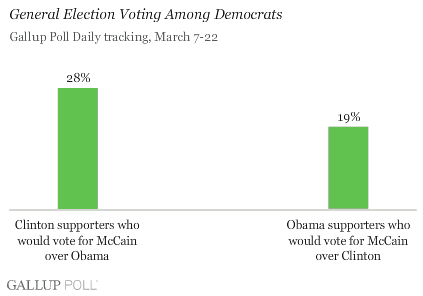
Sure, I have my preferences for one candidate versus another because Obama and Clinton have different positions and stances on issues I care about. They also have different styles of leadership. That doesn't mean that I think either one is worse than McCain. In fact, since McCain has shed his underdog image to becoming the Republican Party's rising star, making huge gains in the primaries and effectively securing the nomination, he's drawing himself further to the right to secure the Conservative vote.
My biggest fear is that 2008 will become another 1968, where liberals and progressives became so entrenched in their support for candidates (albeit that had very differing positions on the war and the cultural divide) that it broke the party for the next thirty years. This year we have an opportunity to strengthen our common goals and fight collectively on issues that we share a part of. It doesn't mean that we can't be critical; it also doesn't mean that we can't push for our electeds and our candidates to be more accountable to our issues. It does mean that we become smarter and more strategic about this upcoming election... Regardless of who the Democratic nominee is, we also work to ensure we elect someone whom we can work with for the next 8 years.
And if ya don't believe me? Well, don't take my word for it:
Especially when a recent Gallup Poll shows that a large number of Democrats would vote overwhelmingly for McCain if their favored candidate doesn't win the primary.
Sure, I have my preferences for one candidate versus another because Obama and Clinton have different positions and stances on issues I care about. They also have different styles of leadership. That doesn't mean that I think either one is worse than McCain. In fact, since McCain has shed his underdog image to becoming the Republican Party's rising star, making huge gains in the primaries and effectively securing the nomination, he's drawing himself further to the right to secure the Conservative vote.
My biggest fear is that 2008 will become another 1968, where liberals and progressives became so entrenched in their support for candidates (albeit that had very differing positions on the war and the cultural divide) that it broke the party for the next thirty years. This year we have an opportunity to strengthen our common goals and fight collectively on issues that we share a part of. It doesn't mean that we can't be critical; it also doesn't mean that we can't push for our electeds and our candidates to be more accountable to our issues. It does mean that we become smarter and more strategic about this upcoming election... Regardless of who the Democratic nominee is, we also work to ensure we elect someone whom we can work with for the next 8 years.
And if ya don't believe me? Well, don't take my word for it:
Monday, February 11, 2008
I survived the 8 hour Portland Democratic Caucus... and became an Obama delegate in the process.
Everyone’s been talking about hope lately.
I’ve been trying to find it for myself. With expected 8 inches of snowfall, long lines to register for the caucus that spanned several city blocks, and for a few folks who entered into caucus, officials telling you to vote absentee because there wasn’t enough room for everyone to caucus–I couldn’t help but feel overwhelmed with hope. Let’s provide some context: this city is so small that we’re really not used to waiting for anything except shopping lines at the supermarket. But thousands of people turned out to the Portland Democratic Caucus this past Sunday, with an inspiring amount of young people, as well as many immigrants and people of color turning out to vote. While the event was suppose to start at 4pm at Portland High School, we didn’t even finish registration until the last person in line came through after 7pm. For many caucus attendees, it was probably enough to kill the spirit.
But it wasn’t. As Massachusettes Governor Deval Patrick said after giving us a speech in the gymnasium, “there’s a lot of energy here.”
For everyone’s exhaustion, impatience, and confusion, there was enough hope and even more importantly, a sense of urgency that somehow we’re a part of something bigger. We’ve been told that this will be the most important election in our lifetime and yesterday demonstrates how we’re listening loud and clear. For many of the young people present, it was their first time participating in a caucus.
Within my ward and precinct caucus, folks were showing amazing solidarity by sharing food, offering rides to caucusers who were stranded because the nearby parking garage closed early on Sundays, and calling their friends to find out and letting everyone know the rest of the state’s results. In short, I haven’t felt the same kind of “we’re in this together” feeling since the anti-war protests in 2004. We knew that if we started the caucus process even when there were still people downstairs registering, we would be disenfranchising their votes.
I stuck around an extra hour after the delegate amounts were assigned for Obama and Clinton, in order to help vote on delegates to the State Convention in May. On a whim, I decided to run for a delegate because it would be an amazing chance to learn more about Maine’s political process. In addition, there were only three people of color left in the room who wanted to be delegates to represent one of Portland’s ethnically and economically diverse neighborhoods. Besides, after surviving the eight hour caucus, what better way to wrap up the night than to represent your hood at the state level?
Rarely do I like to jump onto candidate bandwagons often because I don’t find many candidates that reflect similar values or strategies nor inspires me to throw myself into their campaign. And while I had favored other presidential candidates before jumping onto the Obama train, a big part of what has changed my perspective has been how Obama’s campaign mobilized and inspired many youth and people of color not just nationally, but here in Maine too. Barack Obama has been someone that has inspired many of my friends–both political and apolitical alike… He’s the reason why my sister, who will turn 25 in March, felt inspired and motivated to actually register and vote in the 2008 California primary for the first time in her life. And even despite my critiques of Obama, I still stand by him because he’s able to harness real power: to inspire and empower people not just to believe in the candidate or even the movement, to but believe in yourself to be an agent of change.
I’ve been trying to find it for myself. With expected 8 inches of snowfall, long lines to register for the caucus that spanned several city blocks, and for a few folks who entered into caucus, officials telling you to vote absentee because there wasn’t enough room for everyone to caucus–I couldn’t help but feel overwhelmed with hope. Let’s provide some context: this city is so small that we’re really not used to waiting for anything except shopping lines at the supermarket. But thousands of people turned out to the Portland Democratic Caucus this past Sunday, with an inspiring amount of young people, as well as many immigrants and people of color turning out to vote. While the event was suppose to start at 4pm at Portland High School, we didn’t even finish registration until the last person in line came through after 7pm. For many caucus attendees, it was probably enough to kill the spirit.
But it wasn’t. As Massachusettes Governor Deval Patrick said after giving us a speech in the gymnasium, “there’s a lot of energy here.”
For everyone’s exhaustion, impatience, and confusion, there was enough hope and even more importantly, a sense of urgency that somehow we’re a part of something bigger. We’ve been told that this will be the most important election in our lifetime and yesterday demonstrates how we’re listening loud and clear. For many of the young people present, it was their first time participating in a caucus.
Within my ward and precinct caucus, folks were showing amazing solidarity by sharing food, offering rides to caucusers who were stranded because the nearby parking garage closed early on Sundays, and calling their friends to find out and letting everyone know the rest of the state’s results. In short, I haven’t felt the same kind of “we’re in this together” feeling since the anti-war protests in 2004. We knew that if we started the caucus process even when there were still people downstairs registering, we would be disenfranchising their votes.
I stuck around an extra hour after the delegate amounts were assigned for Obama and Clinton, in order to help vote on delegates to the State Convention in May. On a whim, I decided to run for a delegate because it would be an amazing chance to learn more about Maine’s political process. In addition, there were only three people of color left in the room who wanted to be delegates to represent one of Portland’s ethnically and economically diverse neighborhoods. Besides, after surviving the eight hour caucus, what better way to wrap up the night than to represent your hood at the state level?
Rarely do I like to jump onto candidate bandwagons often because I don’t find many candidates that reflect similar values or strategies nor inspires me to throw myself into their campaign. And while I had favored other presidential candidates before jumping onto the Obama train, a big part of what has changed my perspective has been how Obama’s campaign mobilized and inspired many youth and people of color not just nationally, but here in Maine too. Barack Obama has been someone that has inspired many of my friends–both political and apolitical alike… He’s the reason why my sister, who will turn 25 in March, felt inspired and motivated to actually register and vote in the 2008 California primary for the first time in her life. And even despite my critiques of Obama, I still stand by him because he’s able to harness real power: to inspire and empower people not just to believe in the candidate or even the movement, to but believe in yourself to be an agent of change.
Saturday, January 19, 2008
Dr. King Panel Discussion
Today I was on the MLK Panel for the Maine Humanities Council and NAACP conference at USM. It was held in a university lecture hall, so as I walked onto the stage mentally kicking myself for my wardrobe selection (why did I choose today to wear my jean jacket of all things?), my confusion about the panel itself (the topic I was told it was going to be, actually wasn't the topic in question), or just the intimidating fact that not only was I the youngest, the only woman, the only one without a grad degree, and of all things--wearing a jean jacket. Wow.
The panel was actually fun, much to my surprise! And the crowd was incredibly insightful and responsive to our commentary. And, yes finally we can start talking about King's contribution as part of a network of social movements that have happened, currently occurring, or will occur.
Here's part of my contribution I gave for the panel... I changed some parts so it's not the complete thing:
It’s true that we typically don’t hear the two words “struggle” and “movement” on Martin Luther King Day. I’d also offer another word that we don’t hear: organize. For the last six years I’ve been in Maine, I’ve spent it organizing for affordable housing, racial justice, higher education, labor, and health care, with some of the most talented and creative student groups and organizations.
Truthfully, I don’t know if I could be doing the kind of work I’m doing today if I didn’t learn from Dr. King that the conditions of one’s oppression could be changed and that organizing can be a powerful tool to bringing about that change.
I like to think that King’s legacy is still important and extremely relevant even for young people today. However, as an organizer and someone who is fascinated with social movements, my concern about his relevancy asks what aspects of King’s legacy get acknowledged. Much of his work achieved real wins to ensure African Americans could live their lives in dignity and respect, with equal rights that were guaranteed under the law and enforced. But his legacy and meaning is more than just the “I Have A Dream Speech”. What I think is the most relevant of King’s legacy is that the struggle for any kind of equality, any kind of justice is interconnected. What strikes me about King was his last days, he was in Memphis to support the majority Black garbage workers who were on strike because they had horrible working conditions and unfair wages for what was considered a dangerous occupation.
King’s relevancy right now to young people depends on how we utilize his legacy of collective action in a contemporary context. Right now, we are still facing many of the same battles that were fought four, almost five decades ago, in the areas of institutional racism, gender equity, even how to build and maintain sustainable coalitions across race, gender, and class to promote broad systemic change. It’s become easy amongst those who are marginalized to play into the “Oppression Olympics”, which we can even see played out in the presidential debates right now: between gender and race; which subjugated identity is more oppressed? It does nothing to change the conditions of those who suffer, only to promote more divisiveness amongst groups whose oppression stems from the same source.
Lastly, I want to say that what makes King’s legacy relevant to young people today, is how they take that history, the lessons of the Civil Rights Movement, and how it can be used as a tool for real community change. When I was learning about the Civil Rights Movement and heard about the incredible work of Dr. King… I was thinking: who is going to be the next Dr. King for our generation? It’s important to have heroes and leaders, only so much that those leaders are able to inspire or teach us how to be lead in our own right. Because often times, we often think we should be waiting for that special, charismatic someone who will lead us the fight against one injustice or another. So many people are taking action in our community, everyday heroes who are living King’s legacy, yet who don’t get recognized.
The panel was actually fun, much to my surprise! And the crowd was incredibly insightful and responsive to our commentary. And, yes finally we can start talking about King's contribution as part of a network of social movements that have happened, currently occurring, or will occur.
Here's part of my contribution I gave for the panel... I changed some parts so it's not the complete thing:
It’s true that we typically don’t hear the two words “struggle” and “movement” on Martin Luther King Day. I’d also offer another word that we don’t hear: organize. For the last six years I’ve been in Maine, I’ve spent it organizing for affordable housing, racial justice, higher education, labor, and health care, with some of the most talented and creative student groups and organizations.
Truthfully, I don’t know if I could be doing the kind of work I’m doing today if I didn’t learn from Dr. King that the conditions of one’s oppression could be changed and that organizing can be a powerful tool to bringing about that change.
I like to think that King’s legacy is still important and extremely relevant even for young people today. However, as an organizer and someone who is fascinated with social movements, my concern about his relevancy asks what aspects of King’s legacy get acknowledged. Much of his work achieved real wins to ensure African Americans could live their lives in dignity and respect, with equal rights that were guaranteed under the law and enforced. But his legacy and meaning is more than just the “I Have A Dream Speech”. What I think is the most relevant of King’s legacy is that the struggle for any kind of equality, any kind of justice is interconnected. What strikes me about King was his last days, he was in Memphis to support the majority Black garbage workers who were on strike because they had horrible working conditions and unfair wages for what was considered a dangerous occupation.
King’s relevancy right now to young people depends on how we utilize his legacy of collective action in a contemporary context. Right now, we are still facing many of the same battles that were fought four, almost five decades ago, in the areas of institutional racism, gender equity, even how to build and maintain sustainable coalitions across race, gender, and class to promote broad systemic change. It’s become easy amongst those who are marginalized to play into the “Oppression Olympics”, which we can even see played out in the presidential debates right now: between gender and race; which subjugated identity is more oppressed? It does nothing to change the conditions of those who suffer, only to promote more divisiveness amongst groups whose oppression stems from the same source.
Lastly, I want to say that what makes King’s legacy relevant to young people today, is how they take that history, the lessons of the Civil Rights Movement, and how it can be used as a tool for real community change. When I was learning about the Civil Rights Movement and heard about the incredible work of Dr. King… I was thinking: who is going to be the next Dr. King for our generation? It’s important to have heroes and leaders, only so much that those leaders are able to inspire or teach us how to be lead in our own right. Because often times, we often think we should be waiting for that special, charismatic someone who will lead us the fight against one injustice or another. So many people are taking action in our community, everyday heroes who are living King’s legacy, yet who don’t get recognized.
Monday, January 14, 2008
Upcoming Event: Martin Luther King, Jr. Day
For more information, go here: http://www.portlandmlk.net/
Martin Luther King, Jr., Observance 2008
Building on a Legacy: The Construction of Social and Economic Justice
Interfaith Dialogue
Wed., Jan. 16, 7:00 p.m.
USM Glickman Library, 7th floor, Portland
Event details >>
Reconsidering Martin Luther King, Jr: A public conference on his role and legacy
Organized in partnership with the Maine Humanities Council
Sat., Jan. 19, 9:00 a.m.
USM Hannaford Hall, Portland
Event details >>
23rd Annual Music & Gospel Concert
Sun., Jan. 20, 6:00 p.m.
Merrill Auditorium, Portland
Event details >>
27th Annual Breakfast Celebration
Mon., Jan. 21, 8:00 a.m.
Holiday Inn by the Bay, Portland
Event details >>
Eyes on the Prize
Screenings and Discussions
Mon., Jan. 21, various times
starting at 11:30 a.m.
Maine Historical Society, Portland
Event details >>
RELATED EVENTS
NAACP Portland Branch - MLK Observance
P.O. Box 18198, Portland, Maine 04112, (207) 253-5074
Interfaith Dialogue
Liberty And Justice For All…If Not Now, When? If Not You, Who?
Wed., Jan. 16, 7:00 p.m.
USM Glickman Library, 7th floor, Portland
Free and open to the public
2008 represents the fortieth year since Dr. King’s assassination. This year’s event will take a brief look at his legacy as a means to specifically address issues of racial discrimination and bigotry, socio-economic disparities, and the status of civil/human rights in Maine. We will discuss what is/is not being done by the interfaith community and whose responsibility it is to advocate for equality and justice. We will expand the discussion to analyze how the business community, political parties/leaders and educational institutions are treating these issues. The goal of the program will be to generate tangible action-oriented ideas to incorporate into existing efforts of eliminating racism and inequality in our state. If not now, when? If not you, who?
Reconsidering Martin Luther King, Jr:
A Public Conference on His Role and Legacy
Organized in partnership with the Maine Humanities Council
Sat., Jan. 19, 9:00 a.m.
USM Hannaford Hall, Portland
Forty years after Martin Luther King, Jr.'s assassination, this public conference will examine his lasting significance. Presentations and workshops will include a review of current scholarship on King, examination of his radicalism, how the civil rights movement was represented in photographs, approaches for the classroom, and how Hollywood depicts the civil rights movement. There will also be an opportunity to learn about Maine’s role in the movement and to meet Mainers who took part in it. CEUs are available for teachers.
For more information and to register, please visit http://mainehumanities.org/mlk/index.html.
23rd Annual Music -- Gospel Concert
I've Been to the Mountaintop
Featuring the Windham Chamber Singers
Sun., Jan. 20, 6:00 p.m.
Merrill Auditorium, Portland
TICKETS: Available online through PortTix or by calling (207) 842-0800.
Purchased in advance: $12/adults, $5/youth 12 and under
At the door: $15/adults, $8/youth 12 and under
This year's concert theme, I've Been to the Mountaintop, is taken from the last speech delivered by Dr. King on April 3, 1968. We will take this opportunity to replay portions of that speech in opening the concert so we are immediately connected to the purpose of the evening in honoring Dr. King. The concert will feature the Windham Chamber Singers, the gospel choirs of Brunswick Naval Air Station and Green Memorial AME Zion Church, Rock My Soul, ASERELA Sudanese Choir, and Sounds of Angels Central African choir. Other performers include the Iranian Choir and the traditional Peruvian instrumental sounds of Sergio Espinoza.
27th Annual Breakfast Celebration
Mon., Jan. 21, 8:00 a.m.
Holiday Inn by the Bay, Portland
Followed by a wreath-laying dedication at Monument Square
TICKETS: (Ticket Request form)
$20/adults, $8/youth 12 and under
Tickets are not available at the door and must be purchased in advance. Please use our Ticket Request form to purchase tickets (You'll need Acrobat Reader, which you can download here). Please call 253-5074 for more information.
Dr. Susan Rice, senior fellow on foreign affairs at the Brookings Institute, will serve as this year’s keynote speaker. Dr. Rice is from an African American family that traces their roots to the early 1900s in Maine.
Eyes on the Prize: Screenings and Discussions
Mon., Jan. 21, various times starting at 11:30 a.m.
Maine Historical Society, Portland
Free and open to the public
Partnering with the Maine Historical Society, Maine Humanities Council and the University of Southern Maine President’s Office, the NAACP will show approximately 5 hours of the 14-hour series with guest facilitators leading discussions immediately following each segment.
Other Related Events
Making Freedom: Maine’s African American History Series
Monday, January 14, 2008, and continuing on dates listed below
The NAACP has partnered with Primary Source, a non-profit educational organization, in offering a series on Maine’s African American history. The series begins on January 14 and will continue on January 21, 28, February 4, 11 at Portland High School Auditorium. For the annual NAACP Black History Month program, our presentation on Malaga Island will serve as the Making Freedom class on February 4. Guest speakers will be featured throughout the series. CEU credits are available for educators. Registration required. For more information, call 942-7146 or visit www.primarysource.org.
2008 Election Year: “Constructing Democracy”
UNIVERSITY OF NEW ENGLAND'S Annual Martin Luther King, Jr. Celebration
Featuring Staff From The Highlander Research And Education Center
Various dates in January (please see below)
As part of the 21st annual Martin Luther King Jr. Celebration, the University of New England hosts a residency with staff from the Highlander Research and Education Center in New Market, Tennessee. The Highlander Center, which celebrated its 75th anniversary last fall, has a long history of supporting social justice movements, grassroots activism, and bringing individuals and groups together to envision and effect social change. It was one of the leading training centers for many of the country’s best-known activists during the civil rights movement. All of the Highlander Center’s programs are unified by the common theme of “Constructing Democracy,” which means building a society in which all people can participate in the decisions that affect their lives. Elandria Williams, a youth and community organizer on the Highlander’s Education Team, will be the featured speaker on the University Campus in Biddeford January 22-24th. Anasa Troutman, a Highlander staff member who uses arts and culture for activist organizing and social change will be the featured speaker on the Westbrook College Campus in Portland January 30-February 1st.
For more information on the University of New England events listed below, please visit www.une.edu/studentlife/multi/multicultural/mlk.
All MLK, Jr. events on the University Campus in Biddeford will be facilitated by Elandria Williams from the Highlander Center and are free and open to the public.
Socrates Café: Racism and Oppression in our Community?
Tuesday, January 22 at 7:00 p.m.
St. Francis Room, Library, UC Campus in Biddeford
UC Keynote Address: “Constructing Democracy”
Elandria Williams from the Highlander Center
Wednesday, January 23 at noon
Multipurpose Rooms, Campus Center, UC Campus, Biddeford
A Service & Community Involvement Fair will be held at the same time and location.
“Leadership for Activism” Workshop
Wednesday, January 23 at 7:00 p.m.
Multipurpose Rooms, Campus Center, UC Campus, Biddeford.
To register for this workshop email ehavu@une.edu
All MLK, Jr. Events on the Westbrook College Campus in Portland will be facilitated by Anasa Troutman from the Highlander Center and are free and open to the public.
WCC Keynote Address: “Why We Can’t Wait”
Anasa Troutman from the Highlander Center
Wednesday, January 30 at noon
Ludcke Auditorium, WCC Campus, Portland
Socrates Café: Racism and Oppression in our Community?
Wednesday, January 30 at 5:00 p.m.
Cahner’s Lounge, Hersey Hall, WCC Campus, Portland
“Initiating Conversations: Tools for Change” Workshop
Thursday, January 31 at 1:00 p.m.
Alexander 07, WCC Campus, Portland
“Engaging Communities through the Arts” Workshop
Thursday, January 31 at 6:00 p.m.
Alexander 07, WCC Campus, Portland
Other UNE Martin Luther King, Jr. events will include UNE Days of Service and Read-In Events at local elementary schools in Biddeford and Portland. For more information visit www.une.edu/studentlife/multi/multicultural/mlk.
Martin Luther King, Jr., Observance 2008
Building on a Legacy: The Construction of Social and Economic Justice
Interfaith Dialogue
Wed., Jan. 16, 7:00 p.m.
USM Glickman Library, 7th floor, Portland
Event details >>
Reconsidering Martin Luther King, Jr: A public conference on his role and legacy
Organized in partnership with the Maine Humanities Council
Sat., Jan. 19, 9:00 a.m.
USM Hannaford Hall, Portland
Event details >>
23rd Annual Music & Gospel Concert
Sun., Jan. 20, 6:00 p.m.
Merrill Auditorium, Portland
Event details >>
27th Annual Breakfast Celebration
Mon., Jan. 21, 8:00 a.m.
Holiday Inn by the Bay, Portland
Event details >>
Eyes on the Prize
Screenings and Discussions
Mon., Jan. 21, various times
starting at 11:30 a.m.
Maine Historical Society, Portland
Event details >>
RELATED EVENTS
NAACP Portland Branch - MLK Observance
P.O. Box 18198, Portland, Maine 04112, (207) 253-5074
Interfaith Dialogue
Liberty And Justice For All…If Not Now, When? If Not You, Who?
Wed., Jan. 16, 7:00 p.m.
USM Glickman Library, 7th floor, Portland
Free and open to the public
2008 represents the fortieth year since Dr. King’s assassination. This year’s event will take a brief look at his legacy as a means to specifically address issues of racial discrimination and bigotry, socio-economic disparities, and the status of civil/human rights in Maine. We will discuss what is/is not being done by the interfaith community and whose responsibility it is to advocate for equality and justice. We will expand the discussion to analyze how the business community, political parties/leaders and educational institutions are treating these issues. The goal of the program will be to generate tangible action-oriented ideas to incorporate into existing efforts of eliminating racism and inequality in our state. If not now, when? If not you, who?
Reconsidering Martin Luther King, Jr:
A Public Conference on His Role and Legacy
Organized in partnership with the Maine Humanities Council
Sat., Jan. 19, 9:00 a.m.
USM Hannaford Hall, Portland
Forty years after Martin Luther King, Jr.'s assassination, this public conference will examine his lasting significance. Presentations and workshops will include a review of current scholarship on King, examination of his radicalism, how the civil rights movement was represented in photographs, approaches for the classroom, and how Hollywood depicts the civil rights movement. There will also be an opportunity to learn about Maine’s role in the movement and to meet Mainers who took part in it. CEUs are available for teachers.
For more information and to register, please visit http://mainehumanities.org/mlk/index.html.
23rd Annual Music -- Gospel Concert
I've Been to the Mountaintop
Featuring the Windham Chamber Singers
Sun., Jan. 20, 6:00 p.m.
Merrill Auditorium, Portland
TICKETS: Available online through PortTix or by calling (207) 842-0800.
Purchased in advance: $12/adults, $5/youth 12 and under
At the door: $15/adults, $8/youth 12 and under
This year's concert theme, I've Been to the Mountaintop, is taken from the last speech delivered by Dr. King on April 3, 1968. We will take this opportunity to replay portions of that speech in opening the concert so we are immediately connected to the purpose of the evening in honoring Dr. King. The concert will feature the Windham Chamber Singers, the gospel choirs of Brunswick Naval Air Station and Green Memorial AME Zion Church, Rock My Soul, ASERELA Sudanese Choir, and Sounds of Angels Central African choir. Other performers include the Iranian Choir and the traditional Peruvian instrumental sounds of Sergio Espinoza.
27th Annual Breakfast Celebration
Mon., Jan. 21, 8:00 a.m.
Holiday Inn by the Bay, Portland
Followed by a wreath-laying dedication at Monument Square
TICKETS: (Ticket Request form)
$20/adults, $8/youth 12 and under
Tickets are not available at the door and must be purchased in advance. Please use our Ticket Request form to purchase tickets (You'll need Acrobat Reader, which you can download here). Please call 253-5074 for more information.
Dr. Susan Rice, senior fellow on foreign affairs at the Brookings Institute, will serve as this year’s keynote speaker. Dr. Rice is from an African American family that traces their roots to the early 1900s in Maine.
Eyes on the Prize: Screenings and Discussions
Mon., Jan. 21, various times starting at 11:30 a.m.
Maine Historical Society, Portland
Free and open to the public
Partnering with the Maine Historical Society, Maine Humanities Council and the University of Southern Maine President’s Office, the NAACP will show approximately 5 hours of the 14-hour series with guest facilitators leading discussions immediately following each segment.
Other Related Events
Making Freedom: Maine’s African American History Series
Monday, January 14, 2008, and continuing on dates listed below
The NAACP has partnered with Primary Source, a non-profit educational organization, in offering a series on Maine’s African American history. The series begins on January 14 and will continue on January 21, 28, February 4, 11 at Portland High School Auditorium. For the annual NAACP Black History Month program, our presentation on Malaga Island will serve as the Making Freedom class on February 4. Guest speakers will be featured throughout the series. CEU credits are available for educators. Registration required. For more information, call 942-7146 or visit www.primarysource.org.
2008 Election Year: “Constructing Democracy”
UNIVERSITY OF NEW ENGLAND'S Annual Martin Luther King, Jr. Celebration
Featuring Staff From The Highlander Research And Education Center
Various dates in January (please see below)
As part of the 21st annual Martin Luther King Jr. Celebration, the University of New England hosts a residency with staff from the Highlander Research and Education Center in New Market, Tennessee. The Highlander Center, which celebrated its 75th anniversary last fall, has a long history of supporting social justice movements, grassroots activism, and bringing individuals and groups together to envision and effect social change. It was one of the leading training centers for many of the country’s best-known activists during the civil rights movement. All of the Highlander Center’s programs are unified by the common theme of “Constructing Democracy,” which means building a society in which all people can participate in the decisions that affect their lives. Elandria Williams, a youth and community organizer on the Highlander’s Education Team, will be the featured speaker on the University Campus in Biddeford January 22-24th. Anasa Troutman, a Highlander staff member who uses arts and culture for activist organizing and social change will be the featured speaker on the Westbrook College Campus in Portland January 30-February 1st.
For more information on the University of New England events listed below, please visit www.une.edu/studentlife/multi/multicultural/mlk.
All MLK, Jr. events on the University Campus in Biddeford will be facilitated by Elandria Williams from the Highlander Center and are free and open to the public.
Socrates Café: Racism and Oppression in our Community?
Tuesday, January 22 at 7:00 p.m.
St. Francis Room, Library, UC Campus in Biddeford
UC Keynote Address: “Constructing Democracy”
Elandria Williams from the Highlander Center
Wednesday, January 23 at noon
Multipurpose Rooms, Campus Center, UC Campus, Biddeford
A Service & Community Involvement Fair will be held at the same time and location.
“Leadership for Activism” Workshop
Wednesday, January 23 at 7:00 p.m.
Multipurpose Rooms, Campus Center, UC Campus, Biddeford.
To register for this workshop email ehavu@une.edu
All MLK, Jr. Events on the Westbrook College Campus in Portland will be facilitated by Anasa Troutman from the Highlander Center and are free and open to the public.
WCC Keynote Address: “Why We Can’t Wait”
Anasa Troutman from the Highlander Center
Wednesday, January 30 at noon
Ludcke Auditorium, WCC Campus, Portland
Socrates Café: Racism and Oppression in our Community?
Wednesday, January 30 at 5:00 p.m.
Cahner’s Lounge, Hersey Hall, WCC Campus, Portland
“Initiating Conversations: Tools for Change” Workshop
Thursday, January 31 at 1:00 p.m.
Alexander 07, WCC Campus, Portland
“Engaging Communities through the Arts” Workshop
Thursday, January 31 at 6:00 p.m.
Alexander 07, WCC Campus, Portland
Other UNE Martin Luther King, Jr. events will include UNE Days of Service and Read-In Events at local elementary schools in Biddeford and Portland. For more information visit www.une.edu/studentlife/multi/multicultural/mlk.
Sunday, January 13, 2008
Election 08: What's Great and What We're Getting Wrong, Time and Again...
Election time always makes me feel like it's Christmas: I can hardly wait to find out who's going to take over the White House on Election Day. There's so much preparation that must be done ahead of time: you have to research the candidate platforms, banter with your friend about their candidate of choice while you watch debates, and get real excited (or horrified) at media coverage or candidate responses. And this year, the fact that there's a diversity of candidates from different genders, races, and socioeconomic backgrounds vying for the Democratic presidential nomination is the most exciting part of this year's primary. This is the first time we're seeing a White woman and a Black man compete as front-runner candidates in a major party primary.
In previous elections the media talks about how demographics by gender, race, and age will vote for the amazing selection of (White heterosexual male) candidates, but never how the gender or race of the candidate impacts how these demographics will vote. Now that the media is talking about these issues it's slowly becoming the most disappointing part of the election. It's not the fact that we're having this discussion about race and gender in our society that frustrates me, but how this discussion is played out. For those who aren't sure what I'm referring to yet, it's a new buzz topic in the blogosphere known as the "Oppression Olympics": which is the more subjugated identity, race or gender?
Last week Gloria Steinem, a leader in the second-wave of feminism in the '60s, wrote an Op-Ed piece in the New York Times called "Women Are Never Front-Runners" about the issue of race and gender in presidential primary. Just given the title, you can see the position she's taken on the issue. (Funny how she doesn't consider that, if women are never front-runners, how did Hillary win New Hampshire or maintain a front-runner status?)
Steinem argues that gender is probably the most restricting force in American life, and her argument is compelling. Compared to other democratic nations, we have a pretty low rate of electing women into office. Female voters in Iowa were seen as needing to support Clinton, but male voters are supposedly gender-free in how they vote. Women have tough barriers to face to enter into political office. And she also states that she's "not advocating a competition for who has it toughest".
But Gloria. Yes you are. And what's most disturbing is how your analysis of race and gender perpetuates such divisions in the social movement.
In the opening of her article, Steinem claims that a fictional female official with all of Obama's traits (from political qualifications, marital status, and even racial background) would not be considered a front-runner candidate for political office solely on the basis because she is a woman. She may be right that if Obama was a woman, then her political career and even opportunities may be more limited as a woman. But so would Hillary's, if she was Black. Her oversimplified analysis ignores those who are disadvantaged by both race and gender, wondering which "box" do they fit in. Personally as a woman of color, am I suppose to be a woman or a racial minority first? And how do I know I'm not discriminated against because of one and not the other? Or both at the same time?
What makes her analysis of oppression and marginalization so dangerous is because it asks us to compare oppressions of racism and sexism when it is manifested it in very different ways that have various historical, political, and social contexts. How I'm oppressed as a second-generation Asian American woman is different from how a Black man experiences oppression, which is different from how a working-class White woman experiences oppression. Oppression is wrong, but playing the game of "who's been bleeding or suffering harder and longer" is far more wrong and does nothing to change any situation.
Don't get me wrong; Steinem is correct that sexism is a real part of society, one that plays a very big role in how we perceive Clinton's candidacy and electability. But her broad sweeping justification that because Blacks got to vote before women did, and how Blacks in general "have ascended to positions of power, from the military to the boardroom, before any women" paints an unfair picture that racism is an issue long-resolved. Regardless of where you grow up and where you live, racism is prevalent: in the choices that Black men face to either become an athlete or in jail; how Native Americans are denied adequate health care or educational opportunities at disproportional rates; or racial profiling towards Asian and Latino immigrants who are constantly seen as "foreign" or "illegal"?
The race versus gender debate presupposes an already existing alliance between those who members of that identity group based on race and gender. It also insists that one oppression is more important than another. A major limitation of this kind of identity politics enables a divisive pull between marginalized groups causes us to fight over scraps instead of demanding equal seats at the table. The tendency for second-wave feminists from Gloria Steinem's generation to universalize the experience of gender without understand how power and privilege operate around to race, gender, age, class, sexuality, history, or even location is the became a topic of major criticism for many subsequent feminists such as bell hooks, Gloria Anzaldua, or Audre Lorde.*
Steinem's analysis is disingenuous to what real social change is about. Through this article, she seems to support the idea we should vote based on our identities, or for those who aren't Black or a woman, vote based on who you think is 'most oppressed'. She doesn't give any consideration to the issues and causes Clinton supports, doesn't support, and what she refuses to take position on. According to Steinem, the women in their 50s or 60s who came out overwhelming in support for Clinton and her centrist political positions surely prove that women get more "radical" with age. Her definition of 'radical' scares me as someone who identifies with that term as part of my social practice and political belief. As an activist, what I have grown to know as radical politics doesn't just mean a fundamental political and cultural change, it means being smart and strategic to how that change can be brought about... To know that your struggle for either racial or gender justice is tied into the struggles against all injustice. Steinem's call for support for Clinton to fight the sex barrier, places a hierarchy of one issue over another. It may break a glass ceiling for women in the U.S., lacks any kind of strategy to developing comprehensive social change for all women or marginalized groups.
This is an exciting time where the Left has a chance to reframe the debate around fundamental quality of life issues, yet we're constantly facing messaging left and right about how we should vote between race or gender. Steinem's Op-Ed certainly isn't representative of the views of many feminists I know, but it's reflective of how gender and race issues are viewed in our society. She reaffirms many of the issues people involved in social movements have struggled to change in how we organize: the universalizing of oppression, the invisibility of women of color, and the race discussion as being only about Black and White. But come the next crucial months, we need to keep our momentum to have our voices heard loud and clear to shift the political discussion towards creation of equitable policies supporting universal health care, funding for higher education, worker's rights, the Iraq war, the environment. The next president is only going to be as good as the policies they put forward, and the leadership to unify. Real change doesn't come from breaking glass ceilings, but through the steps we take so everyone has the opportunity to break them, no matter what gender, race, class, or background they have.
* Some suggested reading about third-wave feminism that I like: "This Bridge Called My Back: Writings of Radical Women of Color" ed. Gloria Anzaldua and Cherrie Moraga, "Feminism: From Margin to Center" by bell hooks, "Sister Outsider" by Audre Lorde, "All the Women Are White, All the Blacks are Men, But Some of Us Brave" by Barbara Smith.
In previous elections the media talks about how demographics by gender, race, and age will vote for the amazing selection of (White heterosexual male) candidates, but never how the gender or race of the candidate impacts how these demographics will vote. Now that the media is talking about these issues it's slowly becoming the most disappointing part of the election. It's not the fact that we're having this discussion about race and gender in our society that frustrates me, but how this discussion is played out. For those who aren't sure what I'm referring to yet, it's a new buzz topic in the blogosphere known as the "Oppression Olympics": which is the more subjugated identity, race or gender?
Last week Gloria Steinem, a leader in the second-wave of feminism in the '60s, wrote an Op-Ed piece in the New York Times called "Women Are Never Front-Runners" about the issue of race and gender in presidential primary. Just given the title, you can see the position she's taken on the issue. (Funny how she doesn't consider that, if women are never front-runners, how did Hillary win New Hampshire or maintain a front-runner status?)
Steinem argues that gender is probably the most restricting force in American life, and her argument is compelling. Compared to other democratic nations, we have a pretty low rate of electing women into office. Female voters in Iowa were seen as needing to support Clinton, but male voters are supposedly gender-free in how they vote. Women have tough barriers to face to enter into political office. And she also states that she's "not advocating a competition for who has it toughest".
But Gloria. Yes you are. And what's most disturbing is how your analysis of race and gender perpetuates such divisions in the social movement.
In the opening of her article, Steinem claims that a fictional female official with all of Obama's traits (from political qualifications, marital status, and even racial background) would not be considered a front-runner candidate for political office solely on the basis because she is a woman. She may be right that if Obama was a woman, then her political career and even opportunities may be more limited as a woman. But so would Hillary's, if she was Black. Her oversimplified analysis ignores those who are disadvantaged by both race and gender, wondering which "box" do they fit in. Personally as a woman of color, am I suppose to be a woman or a racial minority first? And how do I know I'm not discriminated against because of one and not the other? Or both at the same time?
What makes her analysis of oppression and marginalization so dangerous is because it asks us to compare oppressions of racism and sexism when it is manifested it in very different ways that have various historical, political, and social contexts. How I'm oppressed as a second-generation Asian American woman is different from how a Black man experiences oppression, which is different from how a working-class White woman experiences oppression. Oppression is wrong, but playing the game of "who's been bleeding or suffering harder and longer" is far more wrong and does nothing to change any situation.
Don't get me wrong; Steinem is correct that sexism is a real part of society, one that plays a very big role in how we perceive Clinton's candidacy and electability. But her broad sweeping justification that because Blacks got to vote before women did, and how Blacks in general "have ascended to positions of power, from the military to the boardroom, before any women" paints an unfair picture that racism is an issue long-resolved. Regardless of where you grow up and where you live, racism is prevalent: in the choices that Black men face to either become an athlete or in jail; how Native Americans are denied adequate health care or educational opportunities at disproportional rates; or racial profiling towards Asian and Latino immigrants who are constantly seen as "foreign" or "illegal"?
The race versus gender debate presupposes an already existing alliance between those who members of that identity group based on race and gender. It also insists that one oppression is more important than another. A major limitation of this kind of identity politics enables a divisive pull between marginalized groups causes us to fight over scraps instead of demanding equal seats at the table. The tendency for second-wave feminists from Gloria Steinem's generation to universalize the experience of gender without understand how power and privilege operate around to race, gender, age, class, sexuality, history, or even location is the became a topic of major criticism for many subsequent feminists such as bell hooks, Gloria Anzaldua, or Audre Lorde.*
Steinem's analysis is disingenuous to what real social change is about. Through this article, she seems to support the idea we should vote based on our identities, or for those who aren't Black or a woman, vote based on who you think is 'most oppressed'. She doesn't give any consideration to the issues and causes Clinton supports, doesn't support, and what she refuses to take position on. According to Steinem, the women in their 50s or 60s who came out overwhelming in support for Clinton and her centrist political positions surely prove that women get more "radical" with age. Her definition of 'radical' scares me as someone who identifies with that term as part of my social practice and political belief. As an activist, what I have grown to know as radical politics doesn't just mean a fundamental political and cultural change, it means being smart and strategic to how that change can be brought about... To know that your struggle for either racial or gender justice is tied into the struggles against all injustice. Steinem's call for support for Clinton to fight the sex barrier, places a hierarchy of one issue over another. It may break a glass ceiling for women in the U.S., lacks any kind of strategy to developing comprehensive social change for all women or marginalized groups.
This is an exciting time where the Left has a chance to reframe the debate around fundamental quality of life issues, yet we're constantly facing messaging left and right about how we should vote between race or gender. Steinem's Op-Ed certainly isn't representative of the views of many feminists I know, but it's reflective of how gender and race issues are viewed in our society. She reaffirms many of the issues people involved in social movements have struggled to change in how we organize: the universalizing of oppression, the invisibility of women of color, and the race discussion as being only about Black and White. But come the next crucial months, we need to keep our momentum to have our voices heard loud and clear to shift the political discussion towards creation of equitable policies supporting universal health care, funding for higher education, worker's rights, the Iraq war, the environment. The next president is only going to be as good as the policies they put forward, and the leadership to unify. Real change doesn't come from breaking glass ceilings, but through the steps we take so everyone has the opportunity to break them, no matter what gender, race, class, or background they have.
* Some suggested reading about third-wave feminism that I like: "This Bridge Called My Back: Writings of Radical Women of Color" ed. Gloria Anzaldua and Cherrie Moraga, "Feminism: From Margin to Center" by bell hooks, "Sister Outsider" by Audre Lorde, "All the Women Are White, All the Blacks are Men, But Some of Us Brave" by Barbara Smith.
Subscribe to:
Posts (Atom)